ラベル soup の投稿を表示しています。 すべての投稿を表示

2011年3月18日金曜日

Okinawa Exile #1: An Embarrassment of Riches / 沖縄#1:大学院生避難所

At four p.m. last Friday, March 11, I landed in Naha Airport. I greeted my friend Sayaka, and she asked me if I had heard about the earthquake. About a day previous, there had been a long but mild tremor in Tokyo. The epicenter had been in the Northeast, and my friend in Sendai had changed his facebook photo to a cartoon of a namazu, the giant catfish of Japanese myth that lives under the earth and makes it rumble.
先週の金曜日、午後4時に、那覇に着きました。空港まで迎えに来た友人(さやか)に「地震のことを聞いた」って聞かれたら、このホラー映画が始まった。

  
But Sayaka didn't mean that earthquake. She meant the one that hit shortly after I took off from Haneda Airport. She pulled me over to the television screen in the terminal. The tsunami had just hit the Northeast. Reporters were disheveled, and a map of Japan blinked red, pink, orange to indicate the tsunami risk along the coasts of the archipelago.
テレビのライブ放送を見て、津波の直後の映像が映った。日本の地図は赤、ピンク、オレンジの色で光っていた。津波の警告を指していた。

The plan had been to get in the car and head off to the north side of Okinawa, but the graphic on the news blinked away merrily, in pink.

We went back to Sayaka's place, and there we (with Sayaka's partner Colm) watched the news. Reporters were all wearing white helmets (and they would do this for a while), and slowly the first reports of casualties trickled in. It was so hard to know the magnitude of the disaster. Initially there were only reports of an elderly man who died of shock, or a woman gone missing in a supermarket. I guess I don't have to tell you in detail about subsequent developments, or describe the footage we've all seen of terrifying walls of water. I can't yet tell if the repeated viewings of the catastrophe made it feel more or less real to me...
さやかのアパートに行って、テレビを見た。まだ死亡の報告がまだ1人ずつで、まだ大丈夫じゃないかなーと思った。今から考えると非常に甘え考えだった。

My original plan was to return to Tokyo on Wednesday evening, but as we watched the footage coming from the nuclear plant in Fukushima, it seemed wise to extend my stay in Okinawa. From reports from friends in Tokyo, the fear and pressure from family, friends, and authorities from abroad were quite trying, and those who had the means to do so relocated to Western Japan or further. It seemed to improve their mental health, at the very least, and relieved pressure on the infrastructure in the capital.
沖縄は5日間の旅行だけという予定だったが、また福島の事故があって、ちょとだけ那覇の滞在を長引いた。東京に残った友達のたくさんは両親や友人の心配に応じて関西に移った。東京でも体が安全だっても、精神的に安心できなかったという人も少なかった。

In the past week, I've experienced too many emotions to relate here. Mostly, I'm so relieved that Christopher and Nori in Sendai are safe and are working hard to coordinate getting help to those in need in their community. I feel a little bit like I want to go home to California and get a hug. But I'm also eager to go back to Tokyo and get on with my life and research (and get a hug). But to all those worried about me: I could not be safer than here in Naha.
今週にいろんな複雑な感情があった。。。疲れて、帰国しようという時もあれば、もう早く東京に帰りたいと強く感じる時もある。

So it is a confusing, uncertain time. But one thing is for sure, even when the mind is mixed up, there is the body that needs to be taken care of, and fed. Nothing makes me happier than to have people to cook for... And now that Ryan has also joined this community of graduate school refugees (and brought my passport!), I'm happy to turn to the issue of food. So let's give words a break for a moment, and turn to more earthy needs...
複雑な時期だというのは確かだ。とりあえず頭を使わないときに、まず体を大事しなければならないと思う。それで、このブログを。。。

Near the place where I am staying is a market. It's got a postwar black market feel. But alongside butchers that sell every cut of a pig and vegetable stands hawking their exotic foliage are small drinking establishments and hip coffee stalls.
今泊まっているところのすぐ近くに栄町市場というマーケットがある。戦後の直後の昭和の味がある。

The fishmonger I usually visit helps me pick fish based on what I want to make. The other day, when Ryan and I stopped by, he broke a baked sweet potato open for us, and we three stood around the trash can gnawing on the insides while throwing scraps of burnt potato skins into the can. We got a fish for a stew.
行っている魚屋さんがいつもどんな料理にどんな魚が適当かと教えてくれる。この間、ライヤンと一緒に行ったら、焼き芋もいただいて、それを食いながら魚を決めた。

Here is the fish's head, after I unwrapped it from the newspaper:
この魚にした:
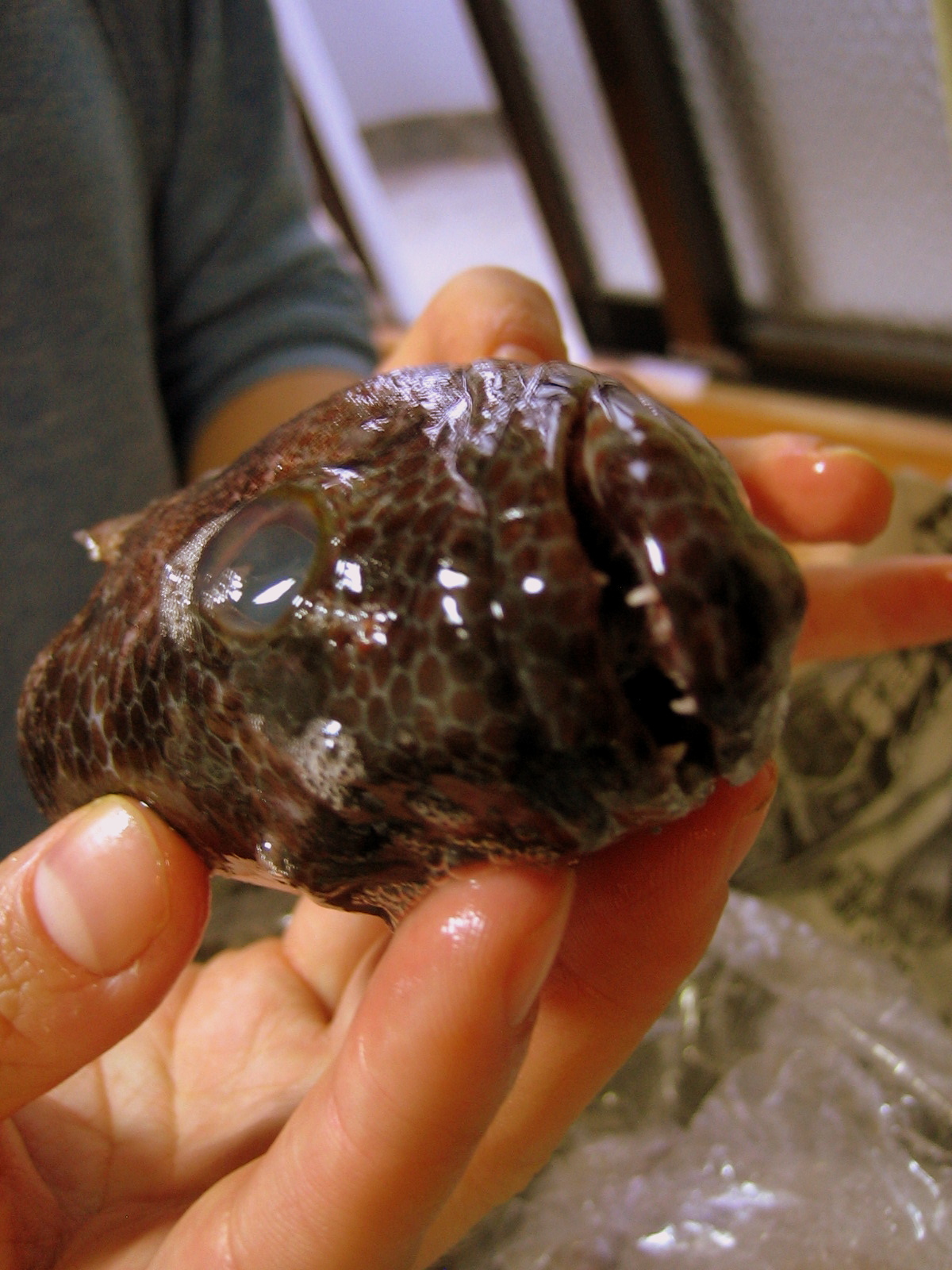
  
With this, I hoped to make a Okinawa-inflected bouillabaisse.
これで沖縄風の魚スープを作ろうと思った。

Any visitor to Okinawa has probably noticed the bottled utchin-cha, or turmeric tea in stores and vending machines. At my market, I found fresh, dirt-covered turmeric:
沖縄のウコン茶も有名で、市場でこのウコンがあった:

It resembles ginger, but cut open reveals a lovely golden hue:
ショウガと似てるけど、このきれいな黄色をしている:

I made the soup base with this, local onions, garlic, Okinawan bacon... and the fish's head:
それとタマネギ、ニンニク、沖縄産ベーコン、魚の頭:


To this, I added tomatoes and the local yellow carrots:
トマトと沖縄の黄色い人参:


Toward the end of the simmer, I added the rest of the fish.

I matched the stew with an island salad. The main green was handama:
島のサラダにハンダマという葉っぱ:
Also wrapped in news. I thought it rather poignant, considered that I feel wrapped up in news myself these days, literally rolled up inside of all that information.

To this, I added some beans:
それに煮たまめ:
Opened up to find:

I simmered the shucked beans in salt water...and added them to the greens, with some shaved carrots, avocado, and sashimi that the fishmonger had insisted I take with me.

Rotating the pots (only one burner in these temporary lodgings), the soup was finally ready:

I reserved the fish head for Sayaka and I to dissect, since we are animals like that.
We picked it clean...

I'm truly embarrassed to be safe on this island, surrounded by such bounty. If only I could send them fish stew, or at the very least some beer (poor Christopher!)
本当に東北に食事が足れない人々がいるので、このごちそうができて恥ずかしい。本当に頭を下げて、こころから「いただきます」を言って、みんなの安全のために祈っています。

I hope it doesn't come off as irreverent to those who are suffering from cold and hunger in the Northeast. To cook is the most powerful method I have to escape from the daily battering by the mass media, and it is with the deepest respect for the producers and the food itself that cook and eat.

In Japanese, the word used in the place of 'bon appetit' is literally the humble form for 'I eat.' With the greatest humility: itadakimasu.

2011年3月8日火曜日

Spring #1: Tiptoeing on Eggshells/ 春#1: 洗練されたらいいけど。。。

Spring! The other day a breeze carried me a hint of incipient spring so powerful that I felt downright drunk. That was quickly drizzled away, but it is undeniable that in pieces and patches spring is poking its way through to us here in Tokyo. 春!この間春の香の漂っていた風に出会った。少しずつ冬の気分が解けるでしょう。

Spring is a delicate season, marked (and marketed) by the ephemeral blossoms of the cherry -- the sakura. In spring, the Japanese nation gathers collectively underneath the pink clouds of sakura, and contemplate the transience of all earthly things as the fragile blossoms flutter down. 春の象徴は優美なさくらでしょう。それで春はつかの間の生について考える季節でしょう。

Funny how that contemplation seems to take the form of mass drunkenness in public parks, as people jostle for position under the cherry trees from early in the day, with their piles of boxed lunches, coolers packed with beer, and maybe even the occasional portable karaoke machine. 考える季節だけでもない。。。飲む季節でもあるの春:週末の上野公園の大衆はお弁当、ビールで朝早くから場所競争を。。。

But the culinary delicacies of nubile like a newly admitted college coed (the school year starts from spring in Japan), and just the palest green, like a cherry-blossom-contemplating drunkard. でも春の食べ物は確かに入学したばかりの女子学生のように自然、それにさくらを眺めている大酒飲みのように薄く緑色している。

For example:
 Tara no me: shoot of the angelica tree. たらの芽。
Yama udo: a relative of ginseng, apparently. 山ウド。
Both these shoots caught my eye at the local green grocer. Although once I got them home I didn't know what to do with them. Or, rather, I knew what I should do with them, but not how. I knew they should be battered and fried as tempura. But I don't know how to make tempura. And since I make it a point of pride that I like to improvise most everything I cook, I wasn't confident that I'd be able to "wing" tempura. この芽で春の目が覚めるとわかった。確かに天ぷらでおいしいでしょうね。でもレシビをよく無視して料理作るの私は天ぷらを挑戦でもいいかな。。。

I'm not really one for delicate cookery. I'll break down a duck. I'll flambé bananas. I'll braise a lamb's head. But follow a recipe? It's the great hurdle that has kept me from getting a handle on "real" Japanese cooking. 和食はがまんが必要。それで、もちろんレシピをちゃんと読んでから作るのも必要です。その理由で私に正式な和食は今でも不思議です。

But enough of these words. A whiff of spring and suddenly I fancy myself a literary lady. Basically, I decided to try to make this the most delicate meal I could possibly have the patience for. I picked three Japanese standards that I have never made: tempura, chawanmushi (a savory egg custard), and suimono (a delicate clear soup). それで、今回は和食挑戦にした:天ぷら、茶碗蒸し、吸い物。

I had the most elaborate fantasy for the chawanmushi. A little research showed me that it's actually a pretty simple dish, just eggs and broth, steamed. To make it even more delicate, I decided I wanted to try to serve it in eggshells. So how does one cut open an eggshell? I cut one slowly with a serrated knife, and at the last moment, it shattered, although remained mostly whole. The second, I attacked with two pins, blew out the insides and then tried to make a little perforation line around the top with the pin:
調べによると茶碗蒸しはそんなに大変なものじゃないので、茶碗より卵の殻に作ったらっと思った。一個をピンで穴を二つ作って、それで中身をだした。最後にピンできれいにあけ口を作れると思ったが。。。

Oh no! It shattered, too. But I had at least two imperfectly opened eggshells. あらっ!それでも使えた。

Chawanmushi is basically eggs, broth, and flavoring with a bit of mirin (sweet cooking sake) and perhaps citrus. I chose to use a little bit of sudachi. 茶碗蒸しにスダチを入れた。
A little grated rind went into the mix. 
Then this went into the eggshells and the eggshells went into the pot with water to steam. それで卵の殻に入れて、蒸し蒸し。。。

Here is the very unsexy photo of my scrambling to prevent all the custard from leaking from the egg with the pin holes, and struggling to improvise egg holders from jars. ちょっと大変だったけど。。。

In the meantime, I peeled the yama udo stalk and sliced it. I parboiled the slices, along with enoki mushrooms for the clear broth soup. それで、吸い物のために山ウドの皮を抜いて、湯通しておいた。

I arranged them in a bowl, as delicately as my clumsy hands could, and attempted a kind of elegant flourish with some sudachi rind. 吸い物の茶碗においた。

In the meantime, I began to worry about the tempura. I read that tempura batter requires very cold water, so I was chilling the water, and just generally worrying. それから、天ぷらのことについて心配し始まった。本当に揚げ物の初心者であるので。。。

What kind of an alchemy is tempura? One that still eludes me. The batter was mixed, the oil was heated, and tested with a bit of batter. The glob went halfway down, then floated up. I coated up a shoot, and dipped it in the oil. It emerged a sassy green, but with no tempura aura. あまり結果が。。。天ぷららしくなかった。

Vaguely tempura-ish fried tara no me. Well, at least the soup's up, and it looks okay...
ま。せめて吸い物は。。。
Ah... delicate. And the chawanmushi?それで茶碗蒸しは?
With a bit of dramatic tobikko (which I also used to great effect here), it turned out to save the show. トビッコに合わせたら、悪くはなかった。

But these simple delicacies still elude me. The mysteries are deep....
Murky...
And dark... like this vision that confronted me in the used oil...
A universe in a frying pan.

ごちそうさまでした!

2010年12月20日月曜日

Winter #2: Red Scare / 冬#2:赤狩り

Hungarians have a strong affinity for the color red. The one spice in all of eastern Europe is crimson Hungarian paprika. Hungarians can boast a strong Marxist philosophical tradition, from Lukács to Mészáros. And now, in the wake of the end of actually existing socialism and with the rise of free market liberalization, red sludge.
 父の生まれ育ちハンガリーが赤と深い関係持ってる。赤いパプリカは東欧中1つだけのスパイスである。ルカーチなどの優れたマークス主義学者の出身である。89年の共産圏の国はそれぞれ自由市場に入ってから最近の災害の赤泥流もある。

It's probably too soon to make light about the red sludge, the name of which implies a slow-moving mass. The footage of which, however, makes it clear that it was much much more terrifying. And also really similar in appearance to gulyás (goulash, for you non-magyars).
たぶんちょっと冗談に早すぎるかもしれないが、この本当に大変な赤泥流の撮影を見て。。。えっ、ちょっとハンガリー料理の有名なグーヤシスープと似てるじゃないかっと(わるいけど)思った。

Now that there is a chill in the air, it's finally soup season for reals. So I thought I'd make up a paprika pot. And as a traveling companion... what more fitting than to create a red-green alliance?
東京は本当に冬に近い天候になったばかりので、本当のスープ季節じゃん。だからこそ今日のパプリカスープ。でも赤緑連合でいかがですか?

I ran into this amiable fellow one night in Shibuya.
ある夜、このかわい子ちゃんとであって。。。


Ah, romanesco from Hokkaido! あっ!北海道産のロマンエスコ!


Exactly how a green should be. Resilient, open to complexity, complimentary to red. And a little weird.
こんなような緑が好き。強い。複雑。変。


Oh yeah, and photogenic. Doesn't hurt to be photogenic.

So, I assigned the greens to the toaster oven. Olive oil, butter, parmesan cheese, slivered almonds accompanied them.
緑はトースターオーベンに。オリーブオイルとバーターとチーズとアーモンドと。


Then, I turned my attention to the Red. それで、赤に戻りました。

There are two keys to Hungarian stews, from gulyás to paprikás: make the onions sweat, and don't burn the paprika. First, I set about making the onions sweat.
ハンガリーのパプリカ料理を作るなら、2つのルールがある:第一、タマネギが「汗をかける」までソーテこと。それから、パプリカを焦げないことだ。まず、タマネギを。。。


Dice those onions. Your tears are nothing in the face of the struggle ahead. So dice them.
タマネギをきる。涙が出ても、きるしかない。

Then saute them over low heat for a long time. I mean like thirty minutes minimum. Get out your reading, and stand over your slowly sizzling pot. Theory and action, people. Fight on two fronts.
それでせめてせめて30分ぐらいをかけてソーテする。がまんだよ。がまん。

After a while, the onions start to look like this:
しばらくタマネギはこの感じになる:

Don't even dream that you are done. Your long march has not yet reached its destination. Make those onions sweat. They will become milky and caramelized, and something different completely. A transformation! But it takes time. Oh, and I like to also add a little lard, too.
まだまだだよ。まだまだ。でもこのところに私は豚バラも入れる。


This is what I mean. These are sweated onions.
こんな感じになるまで、がまんを!

Now: to adhere to the second rule, remove the onions from heat and add the paprika. I don't measure but I always use more than I think I need. Make these sweated onions good and red. Stir in the paprika so it adhere to the oils. Then, you can return to heat (still careful with the paprika until some liquid has been added) and add what you wish. Gulyás is traditionally beef-based (the word itself indicates a Hungarian cowboy, so...), but anything will do. This time I went with chicken and winter vegetables.
それで、第二目のルール:パプリカを焦げないように、なべを火からとって、パプリカ(思うより多め!)を入れて、油に溶かすまで混ぜて、また火に戻す。これで好きなもの(今回は鳥肉、人参などで)と少しだけお水も入れて。。。


And simmer.
とろとろ煮える。

Nothing like a stew to steam up an apartment on a winter's eve. Well, actually, I guess there are other, equally fascinating ways to steam up an apartment on a winter's eve. But...
この部屋のスチーム暖房はスープ。


Still in my top five.
とろとろ。。。


And the red-green coalition?
それで。。。赤緑連合は。。。


Temporary as it was (I ate it right up), it was also...tasty.
おいしかった!ごちそうさまでした!

2010年11月22日月曜日

Autumn #15: Thanksgiving - Boiled, not Baked / 秋#15:アメリカの伝統、日本の材料

Thanksgiving! The gloriously secular celebration of eating! However suspicious its originating mythology may be, I have to admit that I can't suppress my enthusiasm for collective gluttony. And what else is Thanksgiving?
アメリカの感謝際!食いしん坊のとてもとても愛された感謝祭!

Last year, it was two ducks in place of a turkey. This year, lacking both turkeys and ovens, I decided that I'd take the opportunity to give thanks for the bounty of the shitamachi -- the "low city" -- in which I reside.
今年伝統的な七面鳥もオーベンもないチェルは下町の豊かさに感謝します!

Tokyo's shitamachi comprises the eastern neighborhoods of Ueno, Asakusa, Yanaka, and Tabata. It is here, according to Donald Richie, that "still retains what little is left of the feel of old Edo -- distinctly plebian, also fun-loving, less inhibited than those remains of areas where the military aristocracy, the shogunate, observed its rules of decorum." The most significant manifestation of this "fun-loving" shitamachi character is the street food. There are breaded and fried glories to be taken in hand, sweet bean paste of every imaginable configuration, and even -- if you are lucky -- the occasional "scotch egg": a hard-boiled egg ensconced in minced meat and fried. All this and more.
下町の魅力はいろいろですが、注目に値するのはその食い物。ミンチコロッケ、まんじゅうの勢ぞろい、たまにスコッチエグでも(揚げたったミンチに囲まれた卵!)。それに感謝します。


So I got a bone from a local butcher shop to start a mellow soup base for our hotpot Thanksgiving party of nine hungry people.
それで、近所の肉屋さんで買った豚の骨を鍋の汁に。


Broken open, of course, so the marrow can seep out.
骨髄が流れるために折った骨。

I blanched the bone, and put it in a pot to simmer with an apple and star anise.
骨をリンゴとスターアニスに煮た。


I let it go for eight hours or so, adding bits of vegetables along the way.
このままで8時間ぐらい。少しずつ野菜もいれた。

For example, I added some daikon -- a kind of radish, the name of which translates literally as "large root."
例えば、大根を。


This particular "big root" was about the size of my arm.
この大根は文字通り大きくて、腕の大きさぐらい。


The daikon is pretty benign as radishes go.
可愛いね。
So once the bones had simmered and simmered and simmered, I added a touch of soy sauce and sugar, and assembled the shitamachi bounty we'd use for our tableside hotpot thanksgiving feast.
骨が煮て煮て、その間下町の恵みを集まった。

Napa cabbage. Of dinosauric proportions.
白菜の爆弾.


Tentacles peeking out from a fishcake casing. This is getting very Jurassic.
ゲソにハロー。
To distract my arriving guests, I had prepared some crudites (And yes: I still like to pronounce them to rhyme with "Luddites." Croooo-deee-teh, la deee da).
お客さんがだんだん来るので少しだけ前菜も準備した。


Chili-miso and yuzukoshô dipping sauces... just to tide us over until...
野菜とチリみそソース、柚子こしょうマヨ。それで我慢できるかな。。。


Everybody in the pot!
ジャーン!

Alongside this hotpot, we also simmered a pot of this chicken broth, to which I had added ginger.
もう一つの鍋にこのチキンスープを使った。


Holy hotpot! Nothing secular about my feelings toward this food. Hotpot as a communal meal does have something of a primal urgency. We were stripped down to our natural state: just a tribe collecting around the fire, literally grunting into our food. Never mind that the fire was fueled by propane, or that our appetites were whetted not through vigorous cooperative hunting, but through the consumption of cans and cans of beer and malt liquor.
無宗教の感謝際だが、鍋に参った。


Plucking our dinner from the primordial ooze.
みんなが火に集まって、昔の人間のように。


First, a little from pork-bone pot.
まずは豚骨鍋から。。。


Then a little from chicken hotpot...
それでチキンも味見を。。。


And when the nine hungry pilgrims feared that they were at the end...
最後の最後の恐れがあっても。。。


Udon noodles descended into the broth like manna.
うどん。と。。。


For the pork-bone pot, rice and eggs soaked up the last of the broth real nice.
豚骨の鍋にご飯と卵を。

Just one last little detail really set this rite right...
この下町のごちそうさえあれは、他にいることないでしょうね。


Fried garlic shards. Happy thanksgiving!
一つだけが必要:揚げたニンニク。ごちそうさま!