ラベル pasta の投稿を表示しています。 すべての投稿を表示

2011年3月20日日曜日

Okinawa Exile #3: Black Humor / 沖縄#3:黒光

Things are calming down. The disasters in Japan are last week's news for the major American news sources, and even Japanese television has returned to its rotation of melodramas and insipid game shows. Today I had a another 'first talk since this all went down" with a Japanese friend, an Okinawan woman in grad school in Tokyo. She laughed as if she was letting out a long-held breath: "There's a lot to talk about, so let's get a drink when you get back to Tokyo."
ちょっと落ち着いて来たね。アメリカのニュースでは日本の被災よりリビア、日本のテレビでも芸能人の番組が戻って来た。地震、津波、などが起こってから話ができなかった友達と電話で話すと、ほっとした笑い声で:お疲れさま。また東京に着いてから飲みにいこう。

The situation is still very serious in the Northeast, but it sounds like there's room for some laughter there, too. My friend in Sendai reported that there is a healthy does of gallows humor.
まだまだ東北は大変。それでも、仙台にいる友人とチャットで冗談を書いたりできると。。。宮城でもブラックユーモアが盛んだって。

A pregnant friend in Tokyo responded to a worried text of mine that she was not panicking, but picnicking. There's been all kinds of talk about Japanese stoicism in the face of this crisis, many Western observers doing all but coming straight out with the phrase "Samurai spirit." Spare me. There are cultural reasons for the relative calm in Japan, but they have specific historical reasons. A quick refresher course in the public reaction to the Great Kantô Earthquake of 1923 (murder of ethnic Koreans and socialists) will remind us all that there is no unbroken line between the Japanese aristocracy of the Tokugawa Era (1600-1868) and the average middle-class Japanese citizen. But now I'll put the little historian in me back in her box.
東京にいるもう一人の妊娠している友達のメールによると今はパニックよりピクニックだって。いいね、日常生活が戻ると。武士の精神より日常の魅力じゃないですか?

Black humor in Miyagi. Black outs in Tokyo. Black moods here and there. And... a sneaking suspicion that I may be lactose intolerant, leaving me staring into my cup of black black coffee.
宮城にブラックユーモア。東京にブラックオウット。機嫌もたまに黒くなるさー。それで、最近牛乳が飲めない私がコーヒーをブラックで飲みながらいろいろ考えさせる。

So no more cream for me for a while. I feel inspired to give a black dinner, like Esseintes in À rebours. His feast of all-black dishes was given to mourn his lost virility; mine would be to mourn the passing of my voracious omnivorousness. Of course, I can barely believe my enormous good fortune that it is my luxury to lose so little when others have lost so much.
もちろん、牛乳をもう飲めないということはいやだと思っても、ラッキーだなーと考えざるを得ない。

Great also is my fortune that Okinawa's access to fruits of the sea offers me access to squid ink of the deepest blue-black.
沖縄に黒くてもおいしいものあるということもラッキーね。イカスミにはまっている。

I mentioned my desire to cook with squid ink to newly befriended mainland Japan expat, as I sipped my coffee (hold the cream) in a snug stall at the Sakae Machi Market. She guided me over to her favorite fish monger, and he gave be a small bottle of squid ink. He insisted that he had gotten it as a gift, so I shouldn't pay for it. I bought some salmon steaks from him to make it easier to accept his generosity.
イカスミ使って料理を作りたいと栄町市場のカフェで出会ったばかり女性にいうと、魚屋さんに連れて、イカスミをもらちゃった。
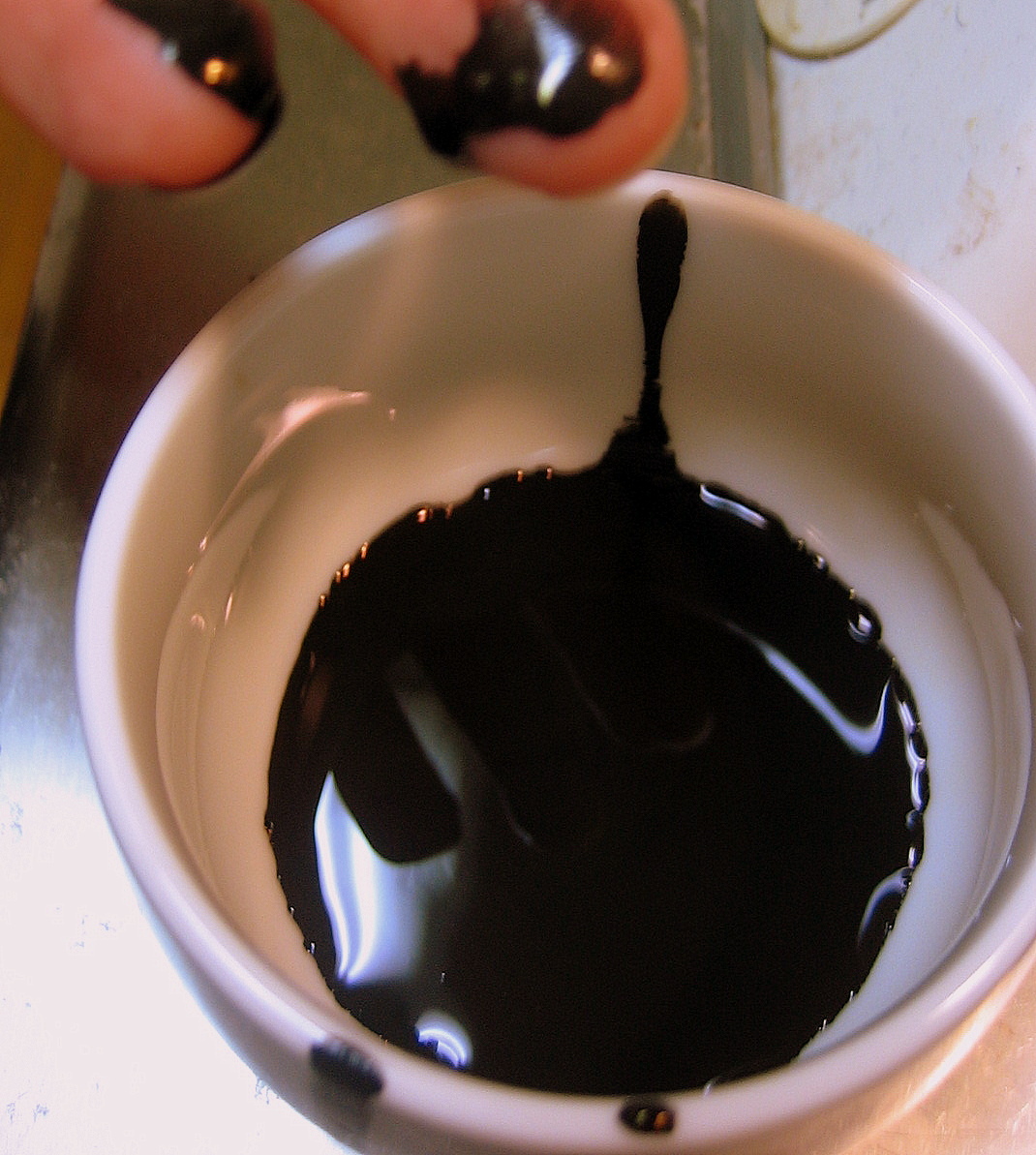
The squid ink truly resembled ink, and tasting it straight offered a salty flavor, deep in umami.
本当に炭のようなイカスミをストレートで味見すると:うまみが深い。

The fishmonger had recommended that I cut the ink with awamori (distilled rice liquor). I added both the ink and the awamori to some sauteed onions and garlic.
泡盛で薄めると魚屋さんに言われた。ですので、イカスミと泡盛をソテーしたタマネギ、ニンニクに入れた。
I had bought some fresh Okinawa noodles, and was eager to besmirch them in this black goo.
新鮮な沖縄そば麵で食べよう!

Rotating pans on the single burner, I also managed to make a light miso soup, using the yomogi and taaimo from my previous post:
みそ汁も先のよもぎ、ターイモを使って、作った。
The salmon was pan fried with salt, brown sugar, black pepper.
サーモンを塩、黒砂糖、コショウで焼いた。

Because I could not really bear such a somber mood, I introduced a bit of play to the meal. Our "green" for the meal would be "sea grapes," another variation on the theme of seaweed.
「サラダ」と言えば、海ぶどうも出した。
I plucked a couple of nasturtiums from the little plant I had bought to brighten my temporary lodgings. The nasturtiums that are plentiful here in Naha evoke California for me, and offer a hint of familiarity within the unfamiliar. I guess I can't seem to give myself over entirely to the black arts...
借りた部屋を明るくするために買ったノウゼンハレンの花も使った。那覇によく見えるノウゼンハレンで出身のカリフォルニアを思い出す。。。

The plate was plenty exotic, dark, and mysterious, however...

It proved to be a delicious harvest from the sea that surrounds us:
It yields darkness...
人生に暗いところもあれば。。。
And it yields life...
いきいきしてるところも。

Over the past few days I've thought a lot about the terrifying rapidity of destruction, and how much longer... frustratingly longer... it takes to build, sow, and reap. It feels like chaos and confusion, uncertainty and danger, are never really that far away.
最近、被災の影響でよく人生の暗いところについて考えてしまう。被災は早い、また人生を立つのは時間がかかる。だれの人生にも、不安、闇、カオス、危険は思うより近いじゃないですか。
It's a tired observation, I guess. But I've never felt it with such urgency. Don't wait until tomorrow to call your friend back. Don't put off that visit. Don't postpone life.
それでも、って言ったら。。。それこそ人生は毎日いきいきと生きるしかないじゃない。言葉でうまく表現できないので。。。

But please, please: also let yourself have the patience for it.

Obligatory end shot of happy colors.
食卓で表現します。

Ever so humbly: Itadakimasu.
いただきます。

2011年2月28日月曜日

Winter #4: California Love / 冬#4:カリフォルニアのラブ

It was my great fortune to be able to spend some time in California this February. California in February makes me wonder why I ever bother to go anywhere else. And not least of all because of the glorious produce. Kale, chard, brussel sprouts, citrus... I was in a tizzy. For seasoning, all I had to do was step out the back door to find lavender, parsley, laurel, and modest jungle of rosemary.
2月に出身のカリフォルニアに帰ることができた。あ。。。2月のカリフォルニア。確かにカリフォルニアドリームだよ。冬の青物もオレンジやレモンもおいしいよ!パーブが必要ならうちの庭でもラベンダー、ゲッケイジュ、パセリー。ローズマリーももちろん。


Beets fetched an extravagant 10USD a root at my local supermarket in Tokyo, so I set out to eat as many beets as possible. My friend Namita (not this Namita) told me about a beet recipe from a show she keeps yapping on about called "Diary of a Foodie". At first I misheard her, and thought the show was called "Diarrhea of a Foodie." That made perfect sense to me, given my experiences with street food from Mexico City to Phnom Penh, but it did seem a rather daring title for a mainstream cooking show. In any case, the point is that once Namita had me thinking about salt-encased beets I knew I had to make some.
東京でビーツを買おうと思っても880円ぐらいかかるのでカリフォルニアに着いてからすぐビーツを食べたかった。友人のナミタから塩に包んだビーツというレシピを聞いたら、是非そのような食べ方を試したいと思った。

A little research yielded the following: mix egg whites with salt, black peppercorns, and herbs (I opted for lavender and rosemary). 塩に卵の白身、ペーパー、ハーブ(私はラベンダーとローズマリーにした)。

Mix it up...混ぜる。。。
Stick your unpeeled beets in a pan with this grit (oh, and I added a celery root).
ペーツ(セロリーの根も仲間に入れた)をこの塩砂に入れる。。。

 Now encase what looks like an alien creeping up from the mud in the salt mix. それでこの蛸のようか宇宙人のようかベーツを塩砂に包む。

 
Bake about 2 hours. 2時かんほど焼く!

Now it looks like your martian is firmly buried on the surface of the moon. それで宇宙人みたいのビーツは月面みたいのスフレに入っているみたいになるとできた。

These beets ended up in a wilted chard and salad for a potluck reunion hosted by Bonnie. このベーツは大学の友人のボニーが行った集まりのサラダに使った。

But I had other plans for the celery root. でもセロリー根に特別な計画あった。

When I'm home, sometimes it's nice to flip the generational relations and pretend to be my parents' grandmother. I guess that would make my parents siblings. Well: maybe I'd just be an affectionate old auntie. But I do like to spend all day in their expansive kitchen, making up goodies in anticipation of them coming home from school. たまに帰るとき、両親のためにおばあちゃんの役割を演じるのが好き。一日中うちの広い台所でおいしいもののいろいろを作りながら。。。

This time I went for the Italian grandmother thing. Tonight the focus would be fagotelli -- stuffed pasta -- with a celery root, parsley, walnut filling.
今回はイタリア系おばあスタイル。フォゴッテリパスタ:セロリ根、パセリ、クルミ入り。

Using the salt-baked celery root, I blended it with parsley, walnuts, olive oil. Basically until it tasted like the most luscious avocado. 塩で焼いたセロリ根にパセリ、クルミ、オリブ油。

To make fagotelli: Prepare the pasta dough (from scratch, naturally) with the egg yolks left from the egg white used in the salt bake, and cut into rectangles. 長方形に切った手作りパスタ生地。
Stuff. 中身を入り。
Fold. 折り。
Repeat. 終わり。
Here are my cute little fagotellis. ジャーン。

To go with these, I planned heaps and heaps of vegetables. First of all, the beet greens I had reserved from the beets could not go to waste. パスタに合わせる野菜のいろいろも作らなきゃ。まずはビーツの青物。

The red stalks of the beet greens made a nice relish when finely chopped and sauteed withvinegar.
赤い部分を細く切って、お酢で煮た。
I wilted the leaves, reserving only the cutest ones for garnishes.
Kale: wilted for salad. Tomatoes: pan roasted for a side. Beef: broiled. (Beef is a vegetable, right?)
ケール:焼いた。トマト:焼いた。ビーフ:焼いた。
At hand I had a colorful California palate to paint the plates. それでお皿に。
It's an interactive medium.
So eat your greens...
And your reds and your yellows.
Buon appetito! ごちそうさま!

2010年11月23日火曜日

Autumn #16: Spaghetti Tacos?!?!? / 秋#16:アメリカ料理の波に乗る

Trendspotter The New York Times alerted the over-thirteen demographic to a new trend in October of this year: Spaghetti tacos. You may wonder about the wisdom of heeding both the Times and the whims of 'tweens. But it kind of sounds like fun. Right? Riiiight?
最近ニューヨークタイムズまで注目されたトレンドで、タコスにパスタ。子供のテレビ番組で冗談作られたス パゲッテイ入りタコスがアメリカの子たちに大人気!えええええっ?


The news reached me just as I was becoming fascinated with another child-geared food trend. After researching Kewpie mayonnaise for this experiment, I was haunted by Kewpie's advertisements for tarako pasta sauce. When it comes to advertising, I'm as impressionable as any child.
こ のニュースを読んだ時に、もう一つの子ども向き食トレンドに夢中だった。たらこパスタ! 


It is probably a sign of my advancing age that I'm so fascinated by these childish whims. In any case, that is the outline of the backstory of what brought me to try my hand at tarako spaghetti tacos.
今晩のメニューの背景はこれで、チェル的なスパゲッテイ入りタコスを試してみよう!


Tarako is one of the many kinds of fish roe that greets the casual consumer at Japanese supermarkets. It is the roe of salted walleye pollack, to be specific (who named this fish?!?!??!). Once I was perusing my local market's roe selection, however, I was drawn instead to tobikko. Tobikko is the roe of flying fish, and it sure did look spry!
スーパーにいったら、たらこよりとびっこの方はおいしそうだった。それで、とびっこパスタタコス!


Lovely little bubbles of fishy saltiness.
おいしそうなとびっこ泡。

I set about making this cream sauce to pair with the tobikko, and drench my spaghetti in. I substituted hakusai for celery, sake for white wine, and shiso for dill, to make it a little more local.
とびっこに合わせるクリームソースを作り始まった。

A little less local is my undying devotion to avocados. I decided to crisp some up with batter usually used for making Japanese fried chicken. To the batter, I added some julienned shiso leaf.
アボカドから揚げも入れたらおいしーかなーと思って、しそと準備した。


These crisped up to look like this:
揚げたら:


The sauce started to simmer:
ソースは沸けば


And simmered:
沸くほど


And it was finally ready to be blended up and run through the sieve.
濃くておいしくなる!

In the meantime, pasta's boiling, and I'm rolling out fresh tortillas with a shochu bottle.
それで、タコスに使トルティーヤを作っている。


Rotating two pans and one pot of boiling water, watching that my toaster oven avocado don't burn... Childish as the inspiration may have been, this meal's preparation is certainly not for kids.
子ども向きの食べ物だが、パスタ、トルティーヤ、アボカド。。。今の台所に子どもは禁止!


Okay: Add tobikko to the cream. Sear some scallops, and get prepared to assemble the tacos.
クリームにといっこ。ホタテを焼いて、準備ができた。

 First: the tortilla.
まずはトルティーヤ。

Then, crispy avocado.
それで、アボカド唐揚げ。


Tobikko cream linguine.
With a garnish of sliced cucumber, topped with seared scallops...
キュウリ、ホタテ. . .


And, what the heck: more tobikko!
. . . ともっともっととびっこ!


And then, finally...
やっと、子どものように手でタコスをつかんで . . .


I let my inner child destroy the taco.
食う!


I read about it, but had to try it for myself. Happily, I report that my idiosyncratic and fishy version was a success.
成功!

Even without tortillas, the pasta with tobikko cream sauce stands up very well on its own.
トルティーヤがなっくても、とびっこクリームパスタでもおいしいね。
Ah, the joys of indulging in a little culinary innocence. The cream and carbs may shave years off of my life, but the taste sensations just added that much more wisdom to my tongue.
子どもに聞く必要あるね。ごちそうさま!

2010年11月18日木曜日

Autumn #13: Strictly Roots / 秋#13:ルーツに戻ろう

Cashing in on the carb-hungry 1980s, my parents supported their young family with a pasta restaurant.
80年代のアメリカででんぷん食品ブームがあった。それで私の両親がパスタ料理屋さんよやりました。


This meant that my earliest memories include not only eating spaghetti with my hands, but also learning how to separate egg yolks from the whites. In retrospect, I'm not sure what the Health Department would have made of snotty nosed kids in the food prep area. Also, I'm really curious what the Department of Labor would have made of Cheru, age 9, standing on a turned-over milk crate and pre-rinsing dishes before putting them in the dishwasher. Aside from an accelerated education of swear words from the staff, it was here that I first learned the bitter dynamic inherent to labor and management. I demanded more than 25 cents an hour, threatening a tantrum strike. My parents threatened to charge me for room and board. I remained on that overturned milk crate.
最初の思い出の中に手でパスタを食うこととパスタ生地を作ること。9歳のチェルは皿洗いとして働いた。その経験で初めて労働者と経営者のつらい関係を味わった。時間給が25セントで、もっと欲しかったチェルは一人ストライキと指名しようとしたとたん、両親の方から下宿の値段上げの発言。チェルは皿洗いを続いた。

This is a long way of saying that I feel I have an intimate connection with pasta.
ごく簡単に言うとパスタと仲の良い間柄あります。

So please forgive me if a lot of my improvisations are pasta-centric.
それで、このブログでパスタ料理がちょっと多めで許してください。

Tonight, I decided to add some spice to my pasta dough with ichimi togarashi.
今晩のパスタを一味唐辛子で辛くしようともって。。。


Lovers of Japanese soup noodle dishes will recognize the package, although the more common expression is not this just-chili powder, but the seven spice -- shichimi togarashi -- version. After adding a little heat, then, I rolled out the dough and roughly cut myself some broad noodles.
これを入れてから粗切りのパスタを切った。


While my lovely, albeit roughly hewn, noodles stood by, I then contemplated another root. This one had nothing to do with metaphors; it was a total stranger to me.
この荒削りのパスタが待ちながら、もう一つのルーツをじっと見つめた。


Having an irresistible affinity for strangers, I picked this one up at the farmer's market. The name read yurine: lily root. It was supposed to be both similar to, and yet unlike, a potato, according to the farmer.
ユリネです。百合の根らしい。ファーマーズマーケットで買った私が農業さんに作り方を聞いてみるとユリネは同時に芋と似てると似ていない。へえええええ。。。


Once I loosened it up a bit, it fell apart into these lovely petal-like segments.
切ると花弁のような形。

In the soup with it! To match the floral theme, I brewed it up with chrysanthemum leaves in a light consomme.
お汁に!花がテームですので菊の葉とコンソメを。


Save the flowers for the romantics. I'm a realist, happy with the roots and the leaves. As long as they are edible.
花はロマン派にいい。唯物主義の私には葉と根でも結構です。食べれるならね。


And what of my patient pasta? It got treated right, pan-fried with butter and fragrant eringi mushrooms.
それで待っているパスタは?勿論愛情含めて、パーターとエリンギでソテーした。


Whether the epiphany comes from eating a hot yam on an Harlem street, or pasta in my tiny Tokyo kitchen, there's something to be said for roots. Especially the delicious ones.
ルーツを大事にした方がいいという考え方ありますね。おいしいなら、大事にしましょう。

 ごちそうさまでした!